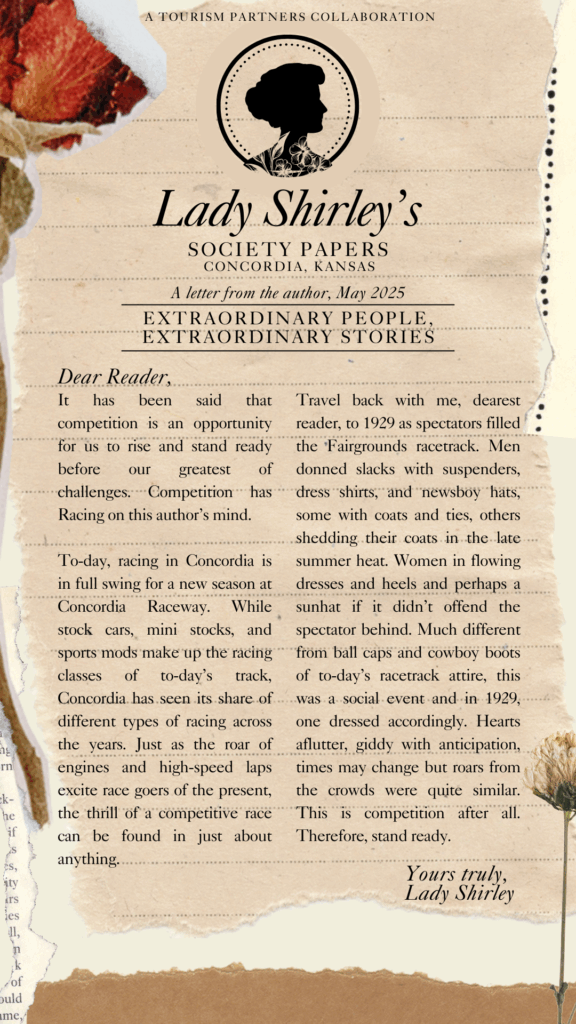
In Cloud County today, our minds go directly to the race cars and races at the Concordia Raceway when the topic of racing comes up. The races are well underway at Concordia’s track for the season. This Fifth Edition of Lady Shirley’s Society Papers is about different kinds of racing in Concordia’s history.
Should the spirit of competition stir inside you, be sure to check out the Concordia Raceway schedule for the season and catch a race. Or if you’re more inclined, make plans to attend the NCK Rodeo for some barrel racing in July.
AND THEY’RE OFF!
Terrapins, greyhounds, thoroughbred horses, and stock cars have graced Concordia’s racing scene over the decades. No matter the nature of the competitor, the competition is what brings the crowds. Humankind will watch just about anything that breeds competition and the excitement it brings. The adrenaline rush of seeing your favorite competitor cross the finish line keeps the spectator coming back for more time after time. This author delights in the images called to mind as men, women, and children filled the seats awaiting the race to begin.
THE TERRAPIN DERBY
In September of 1929, Concordia was finishing up the last day of the Free Fall Festival. The day’s events included a baseball game, parachute jump, and a terrapin derby. The fairgrounds were the site of the day’s events. The baseball game was played in the middle of the racetrack. It was a contest between the Kansas City Monarchs, the longest running franchise in the Negro Leagues, and the Concordia Travelers, a Minor League Baseball Team. Large crowds gathered to see the contest. When the game concluded it was time for the much-anticipated Terrapin Derby. Now, what is a terrapin race, one may ask? Well, a terrapin is simply, a turtle! In those days, a terrapin race was an annual event held at the 101 Ranch near Ponca City, Oklahoma. The annual race in Oklahoma took place just days before. The Millers, owners of the 101 Ranch, herded a thousand turtles into trucks, took the show on the road, and brought the Terrapin Derby to Concordia. The following, printed in a Tulsa newspaper and reprinted in the Concordia News, explains it best:
“One of Oklahoma’s major sporting events, which regularly finds many oil in men attendance, it the Terrapin Derby. The Scene of the race itself beggars description. Imagine thoroughbred terrapins proudly tracing their ancestry back to ‘Old Moss Back,’ a winner of the famous match race against the good hare ‘Aesop’s Dynamite!’ The preliminary heats run 1,000 terrapins at a time. (The finalists emerge)…panting from their heroic exertions, with grooms rubbing their legs and blanketing them against cooling too quickly… And then the final heat, with a $5,000 first prize to the owner of the first terrapin to cross the circular finish line…the tension is something to try men’s souls. At the crack of the starting gun one alert turtle dashes madly for the finish line, gets almost to it and then suddenly remembers that he had promised to go fishing that night with a friend, and lies down and goes to sleep to await his partner’s arrival. Finally some serious-minded entry waddles across the line and the race is over and won.”
The race area was a circle 100 feet in diameter and here at the Concordia event, the arc extended just over the earlier baseball game’s home plate. In the center of the circle, a screened fence starting gate was placed with the hundreds of turtles inside. Each turtle had a number so that bookies and betters could track which turtle was their hopeful winner. Betting on a race was not lawful, but no one cared! First prize was a new six-cylinder Dodge Coach. Crowds whooped and roared cheering on their chosen terrapin. It’s possible many of the terrapins were offended by the remarks being spewed, because they retreated into their shells not to move another inch. As the race progressed with turtles wandering toward the finish line, some might change their trajectory back to the starting point, others deciding the excitement was too much and taking a nap. Off in the distance a large air balloon hoisted a parachuter into the air. Crowds turned to see the spectacle forgetting the races for a few minutes. As the parachutist descended from the balloon, tragedy struck leaving the crowd silent. This author shall return to tell that story another day as it deserves more than a mere mention here. Spectators were now subdued as terrapin number 612 headed straight toward home plate to cross the finish line. First prize went to Tom Kiene, a reporter for the Blade-Empire who bet on number 612 in the name of his girlfriend Lorette. Tom and Lorette were later married, sharing the Dodge Coach, and lived happily ever after.
DOGS CHASING RABITS
Most Kansans hear “greyhound races” and immediately Abilene comes to mind. Our neighbor to the southeast is the “Greyhound Capital of the World.” To-day a museum pays tribute to Greyhounds past and present as well as resident retired greyhound racing dogs, and as the Greyhound Hall of Fame states about their racing days long past, “These greyhounds only chase after your heart and affection.”
Clarence Paulson set Concordia’s greyhound story up for us like this…“It has been said that every dog has its day, but in October of that year in Concordia only greyhounds had their days. The National Coursing Association held its National Coursing Meet at Oscar Carlgren’s farm about three miles north of town on the northeast quarter of section 17 in township 5, range 3, from October 23 to 30, 1932. It is an almost forgotten incident of local history. It happened before Abilene became the Mecca of dog racers.”
Officers and members of the National Coursing Association and spectators came from as far as California, Minnesota, Illinois, Texas, Nebraska, and those more local as well. Over 300 greyhound dogs from 25 states participated in the races. The night of registration, it rained heavily, creating a soppy mess of the track and dampening the spirits of racers and spectators. By morning, the sun was shining and the track dried up. Shakespeare once wrote in Henry V, “I see you stand like greyhounds in the slips, Straining upon the start. The game’s afoot.” This sentiment describes well the crowds that were anxious for the races to begin. Unsure of what to expect from dog races and doubtful of the entertainment quality of watching dogs chase a rabbit, crowds started off small. As the days went on, the locals became more intrigued and crowds increased. Watching the races, hearing the jargon, crowds became ever the more enthusiastic about the races. Similar to the Terrapin Derby, betting was not legal. However, rumor has it that some citizens may have placed their quiet bets on the contests at hand.
The fifth day of racing, October 27, was Concordia Day. The merchants in town coordinated to make the races a part of the commemoration of Concordia Day. A parade, with bands, floats, decorated vehicles, not unlike a parade to-day’s Concordians might witness, took to the streets with leashed greyhounds marching in their midst. On October 30th the final races were held. “Dangerous Mark” came in first in the Futurity, those were the youngest dogs. “Mark Started” was the winner of the Sapling, the slightly older dogs, and “Sunny Sue” and “Sunny Crag” split the purse for the Derby, the oldest of the dogs. Greyhound racing didn’t become a staple in Concordia following that 1932 race series, but the town had a new experience to boast for years before the races became a memory lost to the past.
Greyhounds didn’t leave Concordia and Cloud County’s history, however. John Francis Swafford raised greyhounds, and other dog breeds, for many years. He was the first man in Kansas to raise bloodhounds to track criminals. His hounds were used to track the bank robbers in the Cloud County Bank Robbery. According to the Greyhound Hall of Fame, Mr. Swafford raised, sold, and leased greyhounds for the racetrack from the 1930’s – 1950’s. His two sons carried on the family greyhound business. Jimmy raised greyhounds in Glasco. Bill raised some of the most outstanding greyhounds in Kansas including the famed “Whiz Kids,” whelped in 1969 – the winningest litter of all time with 399 victories. Bill’s daughter, Sydney, and granddaughter, Aron, Olpe, Ks, stayed in the greyhound business making 4 generations, spanning 8 decades.
THUNDERCLOUD PARK
In 1965 a horse racing track opened north of Concordia at the site of the former POW Camp Concordia. Joe Erickson built the racing facilities. Gordon R. Sutton leased the track with Tom Walker and named it Thundercloud Park. It could seat 4,000 spectators and house 200 horses. Impeccable stables, electric timing equipment, photo finish equipment, and a 10-stall electric starting gate were boasting points at the track. Thundercloud Park was only the second Kansas Quarter Horse Racing Association track in Kansas. It was the only one with such a wide scope of facilities, year-round training, and stable accommodations at that time. Gordon’s daughter, Susan Sutton, was among the hands at the track. Gordon was quoted as saying, “Susan is one of the top hands here. She rides and trains here every day of the week … I’ve never raced a horse she didn’t break.” Susan became the first licensed female jockey in Kansas.
Opening day at the new Thundercloud Park was July 24, 1965. With 1400 in attendance, all 140 of the track’s stables were filled with thoroughbreds from Kansas, Colorado, Oklahoma, Texas, Nebraska, Missouri, and Iowa. Pari-mutuel betting had not passed the legislature. However, betting was definitely abundant. Many cast quarter bets on their favorites with their programs and pencils in hand. Though opening day was deemed a great success, and hopes were high for the continued success of the track, training, and boarding operations, Thundercloud Park only lasted a couple years. Today, one can still see the outline of the track in the fields with arial footage.
The absence of pari-mutuel betting in Kansas was the biggest obstacle at getting horse racing to take off. While several other Kansas towns had successful horse tracks, Kansas has remained an equivalent in horse racing as minor leagues to major leagues in baseball. It was a great place to start off and work your way up, but the legalities on betting made the sport difficult to maintain in Kansas. Had Kansas approved pari-mutuel betting, this author might bet Concordia would be at the forefront of the horse racing scene in Kansas and perhaps the U.S.
The Lady Shirley Society Papers are a Concordia Tourism Partners Collaboration.
Information gathered is intended to be factual and entertaining compiled from multiple print sources and interviews of those who remember our histories. For more information on resources, please contact Cloud County Tourism.
Download your printable version here. (Be sure to fold the paper in half lengthwise for ease of readability.)
