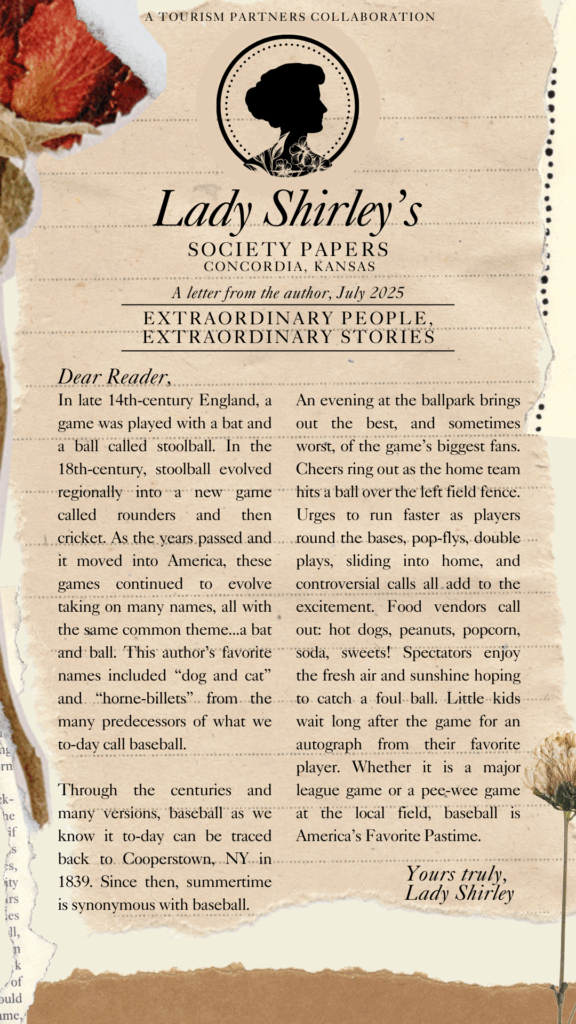
Baseball is in full swing, pun intended, this summer in Cloud County! Teams from across the county compete each week learning the value of hard work, perseverance, and teamwork. When those long hours of practice finally pay off and your team gets the win, the crowd goes wild! Today, baseball competition is high as the game continues to progress over the centuries.
This month Lady Shirley takes us back to the early days of baseball in Cloud County. Grab your popcorn, peanuts, soda, and sweets, we’re ready to PLAY BALL!
EARLY BASEBALL IN CLOUD COUNTY
Only a few short years after Concordia became a town, baseball made its debut. In 1874 the Concordia Clippers took on the Barefoots of Seapo. These first baseball games took place near where the current co-op elevator is located. Glasco added its own team in 1875, the Red Clouds and in 1877, the Lightfoots. In 1890, Glasco and Clyde faced off for the championship at the Cloud County Fair.
The formation of a new team, the Concordia Travelers, in 1910 brought Concordia into a new age of baseball, the minor leagues. Let’s play ball!
CONCORDIA TRAVELERS
Class-A minor league baseball came to Kansas in 1910 with 25 towns supporting teams. The Concordia Travelers were among 7 teams in the Central Kansas League. Junction City, Abilene, Clay Center, Ellsworth, Manhattan, Beloit, and Salina comprised the league. Teams played where the City Park is to-day and fans were charged 25 cents.
The Travelers were managed by Harry Short. Short grew up in Concordia and played shortstop for Kansas State Normal College, known to-day as Emporia State University. He played for many minor league teams in many states throughout his career, known for his speed, fielding abilities, and stolen bases.
Returning home in 1910, he became player-head coach of the Travelers. They went on to win their league championships in both 1910 and 1911. During the 1911 season, the Travelers were accused of “throwing games” to Junction City. Between the Junction City scandal and lack of funds, the Central Kansas League folded soon after the 1912 season ending this era. Two players went on to have short stints in the majors.
BAN JOHNSON
Looking to promote youth baseball in Kansas, the Ban Johnson League entered in 1933. Concordia joined the league in 1935. Named after Byron Bancroft “Ban” Johnson, who formed the major league’s American League, this league was for youth under the age of 21. As an amateur league, players were not allowed to be paid, though most teams had paid managers. Civic organizations or local industry sponsored teams. Players came from all over the country to play on these Ban Johnson League teams. Local merchants provided jobs for the young men. Games were played at the old fairgrounds on East 7th Street, about where to-day’s sports complex is located. Night games and lighted fields were introduced to Kansas in 1932 and proved to be quite popular and exciting. Concordia, the progressive community it had been for many years, of course would have lighted ballfields.
The Ban Johnson team in Concordia was called the Blues. The Blues enjoyed successful seasons, but none so successful as the 1937 season where they won the league and the right to play in the National Championship game. September 11, 1938 the Blues traveled to Kansas City to play Lawrence, beating them 8-0.
A FEW BASEBALL GREATS
Concordia High School has seen its share of outstanding baseball players graduate and play at the next level at Junior Colleges and Universities with great success. A few have made so far as the minor leagues with one former resident playing in the major leagues. Let’s recognize a few.
Concordia High School graduate, Lee Doyen, went on to play ball at Kansas State University. Following KSU he spent one season with the Lockport Cubs of New York in 1943.
Jared Goedert, CHS graduate and Kansas State University player, spent 9 seasons, 923 games, in the minor league affiliate systems of the Cleveland Indians, Pittsburg Pirates, and Toronto Blue Jays on the infield playing 1st, 2nd, and 3rd bases from 2006-2014. He went on to manage the Frisco RoughRiders where he received the Texas League Manager of the Year in 2022. The Frisco RoughRiders are in the Texas Rangers farm system.
Greg Brummett, former Concordia resident, was signed out of draft from Wichita State University. He played 1 season in the major leagues, playing 8 games, for the San Francisco Giants in 1993 and later traded to the Minnesota Twins.
Greg Brummet’s son, Garrett Brummet, a CHS graduate, was signed as an undrafted free agent out of Emporia State University to the Texas Rangers in 2016. He played one year in their minor league system.
POPCORN! GET YOUR POPCORN!
What is a baseball game without popcorn and peanuts? One could also ask, what was Concordia in 1890’s – 1930’s without “Popcorn Jim.” James Albert Gushwa was well-known in Concordia. From this author’s research, his name made its way into many newspapers across this grand state of Kansas.
Jim moved to Cloud County in 1877 to work in Minersville, a coal mining community in the northeast part of the county. He married and had two daughters. Years later he was injured in a train accident which took his right arm and crippled his right leg. Subsequently, he used a crutch to help his mobility. Despite these challenges, Jim never allowed it to slow him down. Newspaper articles from across the state often spoke of the awe and high regard they held him saying a man of his circumstances could have spent his days wallowing but instead worked hard and never let his disability bring him down.
He bought his first popcorn machine in 1893 and ran a successful popcorn business for more than 30 years. He began with a small handheld popper on a red wagon. When he needed his wagon painted in 1905, he said he “doesn’t care what color it is, just so it’s red.” Through much hard work and determination, he managed to save money to purchase a large popper and peanut roaster by 1909. Selling popcorn became quite the profitable business. Between the popcorn wagon and some real estate holdings, he managed to raise two daughters, now a widower, as well as build a nice home in a favorable neighborhood. He would walk his red popcorn wagon from his house on Broadway to the downtown sidewalks of Concordia. Most often he would park his cart at the First National Bank corner. Popcorn Jim decided to make some calculations in 1913 as to how far he walked that year pulling his cart. He estimated that having worked 280 days that year, walking from his home 5 blocks away and back, he conservatively estimated he walked 170 miles and 9 blocks!
Sources say Jim rarely took a day off aside from a few short daytrips and when the weather was especially unfavorable. In 1922 he took his first vacation in 14 years, leaving his daughter to man the cart. It was a major story in the Concordia newspapers. Being that Jim knew all the people strolling downtown, he made fast acquaintances with anyone who may be new to town looking for work. He began to keep a list of all job openings and would guide job seekers to those places for employment. He became known as the one-man labor bureau. While he was on vacation in Colorado no one seemed to know what to do with people seeking employment! An article in the Concordia Press newspaper of 1920 referred to him as a friend of the farmers and said of Jim’s job referrals,
“On one end of his corn popper he has a black board and on this black board he advertises for the farmers. One day he will have a sign on the board, ‘Eight corn huskers wanted,’ and the next day the sign may read, ‘Three corn huskers wanted.’ At another time the sign may read something like this, ‘Have a man with family who wants a job on a farm.’ Mr. Gushwa knows most of the farmers around Concordia and he knows just about what kind of a man they want. He is also a pretty fair judge of human nature and can tell fairly well from looking at a stranger whether he would be any good and he sizes them up before sending them out.”
Jim was a man of many talents. Popcorn man, one-man labor bureau, handyman who built an entire little storage house all on his own despite only having one arm, and widowed father of two girls. To add to that list of most impressive accomplishments, he received the unanimous nomination for police judge in 1895. The Concordia publication, The Alliant, reported
“The vote on the nomination was then taken amid the greatest enthusiasm of the evening. Jim Gushwa was then called for and as he came forward to the sound of his crutches as he hobbled through the aisle brought forth a storm of applause from all parts of the house which ensured him the enthusiastic support of almost every person present. His speech was short, but in it he declared his intention of fulfilling the duties of police judge in a manner than would never cause the good people of Concordia to regret their action in giving him the office”
Jim spoke a few weeks later to The Alliant about his victory thanking the kind-hearted people for their confidence in his abilities and his fine character.
Mr. Gushwa was beloved in Concordia. Most alive to-day have only heard stories. It is this author’s hope that Popcorn Jim’s memory reaches far beyond the last generations who had the honor of knowing him personally.
PEANUTS! SODA! SWEETS!
One cannot mention soda and sweets in Concordia without bringing to mind Lester’s Sweet Shop. Lester Davis bought the Candy Palace in 1948 and renamed it Lester’s Sweet Shop. Lester had been a candy maker in Illinois for 17 years. Lester’s became a Concordia institution. A beloved part of multiple generation’s childhoods, it was THE place to be in town, known for their homemade candies, especially chocolates and fudge, warm roasted nuts, ice cream sundaes, and of course the soda fountain.
While Lester’s is long gone, its memory lives on at the Cloud County Museum. If you’re looking for an authentic soda fountain in Cloud County to-day, scoot down to The Hodge Podge in downtown Glasco.
The Lady Shirley Society Papers are a Concordia Tourism Partners Collaboration.
Information gathered is intended to be factual and entertaining compiled from multiple print sources and interviews of those who remember our histories. For more information on resources, please contact Cloud County Tourism.
Download your own printable version here. (Be sure to fold the paper in half lengthwise for ease of readability.)
