
This Edition of Lady Shirley’s Society Papers brings us ghostly tales from Cloud County. October brings out all the spooky things, jack-o-lanterns, scary movies, people dressing up as witches and monsters, and of course thoughts of ghosts. With “Spooky Season” in full swing, Lady Shirley has some supernatural and not so supernatural stories to share.
EARL’S GHOST
Not every theatre has a ghost, though many tales of unexplainable events lead to the creation of such legends and lore. Having a ghost in a theatre is often considered a good thing. Theatre ghosts mark a theatre’s rich history. If a spirit lingers, something meaningful must have happened there. Many are thought to bring good luck to a performance and protection over the cast and crew of a production. If nothing more, tales of ghostly presence bring creativity, allure, passion, and mystery. It is a sure sign that the theatre is alive with artistic energy.
Our beloved Brown Grand Theatre is no stranger to ghostly tales. For decades, reports of strange noises, moved objects, oddly placed materials, and even apparitions have been attributed to a friendly theatre ghost, Earl Van Dorn Brown. Shall we explore why Earl might wish to spend the afterlife within the Brown Grand walls?
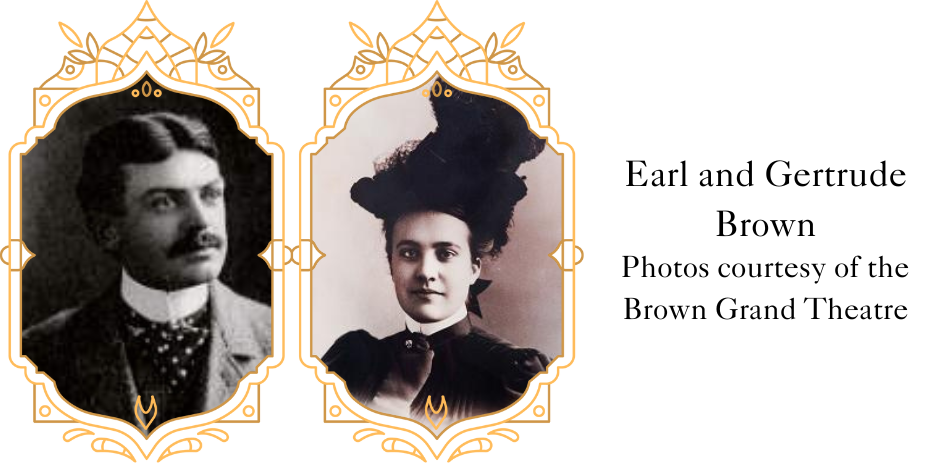
Earl Van Dorn Brown was the only child and son of Colonel Napoleon Bonaparte Brown and his wife Katherine. Legend says that the Colonel agreed to fund the building of a community center, a grand structure that would bring culture and encourage the arts in Concordia as well as provide space for events in the community. The Colonel however did not wish to be involved in the details of building such a structure. He passed that task on to his son Earl who had a love for the arts. Along with his wife Gertrude, a highly educated woman with a love of architecture, they set out to find inspiration for building a theatre. Afterall, traveling troupes of performers were already stopping in Concordia, why not take advantage of their stays and have a grand place for them to perform?
Gertrude’s love of architecture had her working alongside Earl and the building contractors quite closely. She was involved in most every conversation and her touches can be seen all over the theatre, though no one would know. Being a woman, Gertude was not allowed to take any credit for her work. You won’t find her name listed with architects, designers, or contractors. That credit was only allowed to men of the time.
A few short years after the Brown Grand was built, the Colonel passed away. Shockingly, a few months later, Earl died somewhat suddenly and unexpectedly from complications from gallbladder surgery leaving both Brown women widows.
It is said that because Earl was no longer around to give Gertrude the credit she deserved for the Brown Grand, his ghost decided to remain and and it is he that haunts the theatre. His ghost has been seen in the first balcony wearing a coat and top hat as if attending a show. Perhaps he allows himself to be observed when a show is being prepared to give his approval that the theatre is being used appropriately.
Items have been moved only to be found in the oddest of places. Earl doesn’t intend to be a spooky or troublesome ghost, he just enjoys a bit of attention once in a while. For example, nails could be found throughout the theatre barely tapped into the walls, many far from reach. Perhaps as a reminder to those of us here today to recall the building of the Brown Grand? Earl doesn’t want us forgetting our beginnings and perhaps for that sentiment alone, this author wants to believe he haunts the Brown Grand today.
Aside from Earl, this author would share one other ghostly story passed along to her recently. Several years back, the re-teller of this story could not recall the year, Rod’s Thriftway grocery store was having an outside produce sale. Rather than bring all of the produce and other grocery items inside that night at closing, an employee offered to park his camper in the parking lot and watch over the produce that night.
This employee brought along his dog and was enjoying a nice evening once the hustle and bustle of the day subsided downtown. Suddenly, his dog stood at attention, looking intently across the street to the sidewalk in front of the Brown Grand, and began to bark. Curious as to what the dog had spotted, he was shocked to see a man and woman dressed in their finest attire. The woman in a long flowing dress and the the gentleman in a tuxedo and top hat. As they walked together, they approached the Brown Grand’s steps and disappeared inside as if attending a show. However, there were no scheduled performances for the evening at the Brown Grand. Unable to believe what he had just witnessed, the man walked across the street to peer inside where the couple had entered. All was dark, there was no one to be seen inside. He checked the front doors, still unable to reconcile his sighting, but the doors were securely locked.
HAUNTED TOURS
The Brown Grand has hosted many paranormal investigative groups over the years. The stories of Earl have spread and these groups believe they have the capabilities to capture him using modern technology. The idea of hearing Earl speak to us from beyond the veil is beyond this author’s understanding! These groups keep returning in an effort to find evidence of ghostly residents at the theatre. Many have audio recordings and photographic proof that there are multiple ghosts that haunt the Brown Grand. One only need to do a quick Internet search or an inquiry on YouTube to see and hear what these investigators have uncovered.
If you’re feeling especially brave, you may wish to join in on an investigation. There are usually several scheduled each year. Please do see for yourself!
CLOUD COUNTY’S GHOST TOWN
Ghostly tales are fun, and a startle now and then definitely can get your heart racing, but our next tale is not about otherworldly spirits. Instead, we turn to a town that rests undisturbed for almost a century, practically forgotten by time, it’s remnants falling into the earth. Yes, Cloud County has a Ghost Town. Let us journey to Minersville.
Oh, how the Ton has been abuzz of late with the completion and screenings of a documentary about Minersville! Salina Media Connection recently received grants from Humanities Kansas and both the Cloud and Republic Community Foundations. Greg Stephans directed the documentary film that explores the history of Minersville. The town once occupied nearly 500 residents and miners and was spread over 320 acres north and east of Concordia. That land is now privately owned by the Trost family. There are few physical remnants of the once booming mining town, however, the now Ghost Town, lives on forever in the stories preserved.
An article by Patricia E. Ackerman for Kansas! Magazine, describes the mining town well. “Although southeast Kansas produced a third of the nation’s coal more than a century ago, it was unusual to discover coal in the northern part of the state. By 1871, Minersville had established four total shaft and slope coal mines. Mine shafts were 6 to 8 feet in diameter and ranged from 20 to 80 feet deep. To enter the mines, men lay flat on boards suspended by ropes and pulleys. These contraptions were raised and lowered by draft horses. Miners would use picks to extract veins of coal from between layers of stone.”
Minersville, straddling both Cloud and Republic counties, had a general store, post office, school, a church, a cemetery, and they even had a baseball team. Life was good in Minersville and the town boomed. The boom was unfortunately followed by a bust. As trains brought Pennsylvania coal from the east, which was much better burning, Minersville simply couldn’t compete. The Post Office closed in 1899. Residents moved on leaving Minersville to the prairie winds and forces of nature. The last mine shut down in 1945. Dr. Ed Glenn, Republic county historian, sums up our feelings about Minersville quite well in this quote, “The people of Cloud and Republic Counties owe a debt of gratitude to the brave, hardworking homesteaders who took advantage of an opportunity, built a community, and established an economic base for the area.”
GHOST MURALS
No, dear readers, this author has not lost her marbles. Pray, imagine if you will, a wall, aged and weathered by time, upon which the faintest traces of artistry remain. These spectral remnants whisper of a painting that once adorned the surface, often an advertisement. Such is the nature of a ghost mural: a faded image, barely visible, lingering like a spirit, haunting the surface with its presence.
If one looks closely enough around our dear city, you may find these spectral images. Find one between the United Bank & Trust drive through on the wall of the former garage to the west. You can also see the faintest “Garage” lettering on the front of the Cloud County Museum’s Annex building where Cloud County Tourism has their office as well. Spotting these ghost murals, hidden in plain sight, makes for a most interesting scavenger hunt throughout the Ton. Look closely, dear reader, for the past is never truly erased by time.
ONE LAST TALE FROM THE GRAVE
Did you think we could conclude a Society Paper without a bit of secrecy? It pays to have the most interesting of friends and this author has many. The following tale was researched years ago by Susan Sutton when she created “A Walking Tour of Pleasant Hill Cemetery” and brought to the forefront of this author’s attention a short time ago with greater detail from Lori Halfhide, NOTC researcher extraordinaire.
Mr. and Mrs. Nelson Crill were prominent settlers in Cloud County. They arrived in 1871. Mr. Crill was involved in the hotel business. In 1873 he began building The Commercial Hotel. He later sold the hotel which became The Baron’s House. The Concordia Republican reported the following story in 1881:
“Something of a most startling nature is taking place at N. Crill’s. It is the fact that Nelson’s boy, only two months old, and which boy is not related to Mrs. Crill at all, is already commencing to talk, and can utter several words very distinctly. Nelson’s boy is a parrot.”
Mr. Crill passed away in 1912. Mrs. Victoria Crill died in 1921. She passed on a Tuesday, and until her funeral on Friday, their pet parrot, Polly, refused to eat or drink, obviously in mourning. According to Mrs. Crill’s will, she was prepared for this event. Polly was to be chloroformed by a physician and buried with her. Given his last rites, the bird, 42 years of age, was laid to rest in the casket with Mrs. Crill. Both were placed in their mausoleum in Pleasant Hill Cemetary.

Information gathered is intended to be factual and entertaining compiled from multiple print sources and interviews of those who remember our histories. For more information on resources, please contact Cloud County Tourism.
Download your printable copy here. (Be sure to fold the paper in half lengthwise for ease of readability.)
