With America 250 upon us, Lady Shirley felt moved to celebrate by recognizing some of Concordia’s Festival milestones. Concordia has seen her share of festivals over the years and coming together to celebrate does bring out the best in us!

Dearest Reader,
“O beautiful for spacious skies, for amber waves of grain” … Katharine Lee Bates knew just the right words to describe our country. For America is beautiful—and so, too, are her people, as declared in the line, “Crown thy good with brotherhood.”
Brotherhood, however, is less easily achieved than it is sung, for it requires, above all things, participation.
With July 4th and America’s 250th before us, one longs for these lines to be more than ornament, but a true reflection of patriotism and belief in America herself. Dare we hope for such things in the month of our Independence, when they ought to be most evident in her people and celebrations?
Concordia has, over the years, made several admirable attempts at festivity. And, if Lady Shirley may venture a delicate observation, participation is more easily proposed than achieved. This author wonders: are these celebrations of the past seen through rose-colored glasses, or were people simply happier to participate?
Concordia’s Centennial was met with enthusiasm and costume and fanfare. Her Sesquicentennial, alas, was almost denied its moment altogether. Now, as the nation approaches its 250th year, one might expect mounting excitement for such a milestone, for the nation has been celebrating since January. And yet, here, the feeling is gentler—quieter, not entirely absent, but it is curious.
Perhaps the fault lies not in the moment, but in our expectations. For celebration need not be grand to be meaningful. In the search for spectacle, perhaps what we truly require is connection—that people gather, participate, and choose, however briefly, to belong to one another.
Concordia has done this before. She can do so again. She has endured much, yet she remains.
And if this season calls us to anything, it is not perfection in festivity, but persistence in connection—for it is there that brotherhood is truly crowned.
Yours truly,
Lady Shirley
YEAR ONE
If we are to begin, we should do so at the beginning. Imagine a town in its humblest state, and recall that Concordia became a paper town in January 1870. Six months later, the land office opened, and by the end of that first day, 106 homesteads had been entered and 180 pre-emption declaratory statements filed. About six months later, June of 1871, the first festival was held.
The ladies of the Presbyterian church, along with ladies of other churches, hosted a “fruit and ice cream festival.”
The Concordia Empire reported that the ladies, being experienced in such affairs, were “determined to make this, the first festival ever held in Concordia, a perfect success.” Later editions of the Empire confirmed that it was indeed a success, and it became an annual occurrence for a time. It was in those later editions that this author learned the fruit served—varieties not found in the area—had to be sent long distances to arrive in Concordia and was therefore considered quite a rare treat.
50 YEARS
In October 1920, Concordia held a Fall Festival—a grand three-day event and the first of its kind in our town. Other communities had long celebrated festivals and grand affairs, and Concordia wished to be counted among their number. The festival committee reached out across Northwest Kansas for guidance and invited neighboring towns to attend as guests. Atchison was among those who agreed.
Preparations began in earnest. A patriotic color scheme of red, white, and blue was selected, and businesses and residences alike were asked to decorate as a show of unity. Booths were constructed along the downtown streets for merchants and demonstrations. The Concordia Blade-Empire reported that downtown would be completely transformed by their presence. Days before the festival began, more than fifty booths had already been erected. This author cannot help but wish that a photograph existed, for her imagination can only stretch so far before overexaggeration takes hold.
Speaking of overexaggeration, some expected 20,000 people per day to attend the festival. Others suggested a more modest 10,000; thus, a compromise of 15,000 was agreed upon. This author did not uncover final attendance figures. However, according to the Concordia Press, 239 old settlers registered to return for the occasion, with expectations that more than 500 might attend. The Press thoughtfully printed each old settler’s name along with the date of their arrival in the area.
The E. A. Brown Electric Company of Kansas City held the contract for the new White Way highway being constructed through Concordia, extending along Sixth Street. Today, the White Way Car Run still honors that early roadway. The company promised that new lights would be installed before the festival; however, that promise was not fulfilled. With no funds to light three blocks, no desire to hold a festival in darkness, the committee appealed to the city for assistance. The city council contributed $50, and men were sent to local businesses to solicit further donations. The Concordia Electric Company ultimately agreed to complete the work at a discount, ensuring the festival would indeed be illuminated.
The festival committee undertook extensive advertising, including what was described as “papering the state” with posters and handbills across the surrounding region. Posters traveled by train, and letters of invitation were sent to former residents. Reports claimed these notices reached as far as Narka to the north, Colby to the west, Atchison to the east, and Wichita to the south.
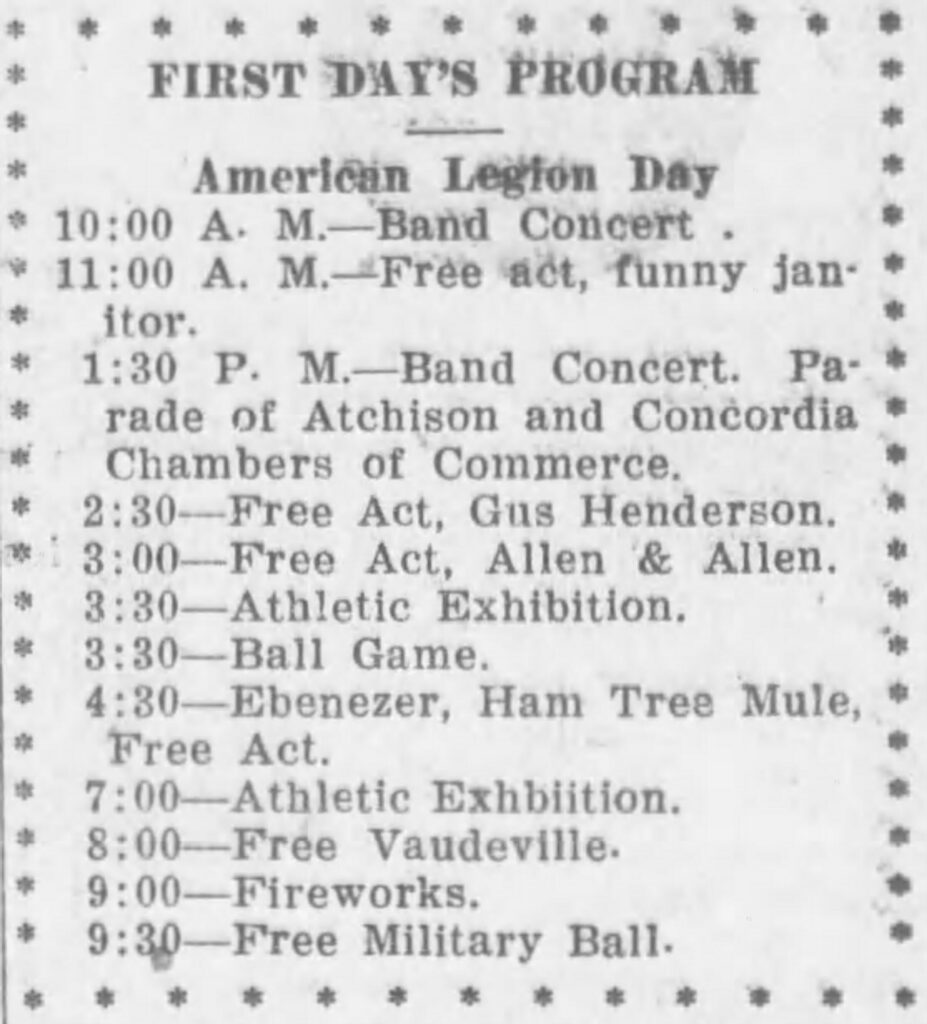
Day One was American Legion Day, beginning with a band concert and concluding with fireworks and a military ball.
Day 2 was Old Settlers, featuring a parade led by the earliest residents. The community was asked to provide automobiles for their comfort. Decorated floats, comic entries, and schoolchildren followed in procession.
Day Three marked Concordia’s fiftieth anniversary with events to celebrate.
100 YEARS
Concordia’s Centennial celebration lasted an entire week. August 6–14, 1971, was filled with events and history.
A book titled Prairie Portrait was created and has proven a valuable source for this author over the course of these Society Papers, offering a wealth of information on Concordia’s history, including a detailed schedule of events and photographs.
Photographs of the event are quite spectacular. A costume company was engaged so that townspeople might be fitted in period attire. A historical pageant, also titled “Prairie Portrait,” featured more than 400 cast and crew and served as a centerpiece of the festivities. A Centennial costume contest was also planned drawing upon both these garments and homemade creations.
Businesses participated in “Old Fashioned Bargain Days,” deemed “the greatest sale ever,” while free buggy rides for children were offered, downtown entertainment, a hospitality center at the American Legion, an art show at Cloud County Community College, and dancing, complete with Centennial Queen coronations filled the first days.
Interfaith services, picnics, and gatherings rounded out the weekend.
City Park was temporarily renamed Centennial Park, where events were held, with the pageant site set up at the Concordia Athletic Field. Frank Carlson served as the Centennial Committee president. Kansas Governor, Robert Docking, was on the schedule as well as several visiting dignitaries.
By the fifth day, much food was enjoyed, pre-pageant activities were in full swing, and Prairie Portrait debuted. The following days featured arts and crafts, four additional performances of the pageant, children’s activities, and a threshing bee and machinery exhibits at the Fairgrounds.
The final day, August 14th, included the dedication . and burial of a time capsule, judging of the Beard Growing Contest, and tours of the Motherhouse. A grand Centennial Parade, barbecue and, one final performance would conclude the week’s events.
It was as grand an event as Concordia has ever seen.
150 YEARS
Concordia spent over a year preparing to celebrate her Sesquicentennial—150 years. Plans and activities had begun in 2020, with several thoughtful nods to the Centennial in the works. A Beard Growing Contest commenced, meetings were in full swing with ideas and a yearlong series of events and merchandise was ordered. Excitement was building steadily.
Then, mid-March 2020, the world shut down. COVID-19 reared its ugly head, and everything came to a sudden pause.
Plans continued, despite uncertainty. Those who recall the shutdowns remember how often life attempted to resume, only to be delayed again. Yet by October 2020, a schedule of activities was released. Though smaller scale than originally planned and shaped by social distancing and other mandates, the committee remained hopeful.
March 13, 2021, the first event was held at the Cloud County Museum—a program on the Cloud County Bank Robbery of 1932. A play on the subject had been performed in 2006 and filmed at that time. It was presented in a special one-time screening the following week on March 20th. The second event, a gospel sing-along, took place in May and the Beard Growing Contest carried on.
A schedule of events was finalized for a celebration in August at the City Park.
A month ahead of schedule, the Time Capsule from the Centennial was opened, without the fanfare it deserved. After recovery, it was found heavily water damaged. The contents that could be salvaged were removed and placed on display at City Hall. New items to place in a new time capsule were requested to be opened in 2071.
August 14th arrived, and the Sesquicentennial commenced in City Park. A free public meal was served along with a beautiful cake decorated with photos spanning 150 years of Concordia’s history created by Clyde’s Wendy Genereaux.
October 2021, a new steel time capsule, designed and fabricated by Concordia Technologies was placed.
Perhaps it was not the grand celebration Concordia had planned, but it endured, once again her resilience in the face of difficulty.
Information gathered is intended to be factual and entertaining compiled from multiple print sources and interviews of those who remember our histories. For more information on resources, please contact Cloud County Tourism.
Download your printable copy here. (Be sure to fold the paper in half lengthwise for ease of readability.)
Listen to Lady Shirley read her introduction letter below.
