
What a whirlwind of a year it has been sharing Lady Shirley’s Society Papers! Who knew Spilling the Tea in Concordia could be so entertaining! We hope you’ve enjoyed Lady Shirley’s tales of intrigue and sometimes scandal. This month she honors two local storytellers who have shared so much of our local history that we should all be grateful they took time to write them down. Without those tales so much would be lost to time and forgotten. She also invites us to write our own stories down. We all have a story to share. Most of those who have played the biggest roles in our histories didn’t even realize how important their stories were at the time.
Dearest Gentle Reader,
How does an author conclude a year of Society Papers? This question has rested upon this author’s heart, for what a whirlwind this year has proved to be! When this journey began, neither this author nor the Concordia Tourism Partners could have imagined how it might grow in such a brief span. The reception has this author grateful beyond measure. To think it all began with stories…
Stories – modest tales which, over time lead us upon grand journeys through history. It is often the smallest threads, spun in parlours and around humble coffee tables, that together weave the richest color to our common story. Any weaver might tell you how easily threads can be lost or forgotten if not gathered and preserved by loving hands.
We seldom see ourselves as the makers of history. Those who shape an era rarely suspect their own significance. However, history is but the sum of countless lives, each with its joys, trials, and triumphs. Your stories will one day become cherished remembrances – treasures no scholar could contrive, no author could retell with the elegance or crafty tongue to do enough justice, nor could any future age replace.
Therefore, I entreat you: take up your pen – digital or ink – and set before you a lovely paper and commit your narratives to the pages of your history. Let posterity proclaim not only the doings of great men and women, but the quiet heroism closer to home. The stories of everyday living. The happiest times, the seemingly mundane, and the most heartbreaking of tales need to be recorded for future generations that they may discover the soul of our community in this age. Who better to tell your story than you?
This author has retold many and relied on the voices from our past, Clarence Paulsen, Janet Pease Emery, Marion Ellet, and countless coffee table story tellers. Though the recollections and recordings of countless tales we’ve spun are valuable beyond any accounting, ‘tis you who knows your story best.
In this town of stories yet untold, it is your stories that shall weave the richest tapestry for generations yet to come.
Yours Truly, Lady Shirley
STORYTELLERS
When thinking of family and friends, it is seldom difficult to know who the storyteller is among our circles. They may not bear the titles of author or historian, yet their words linger in our minds long after the tale is told. In their stories we find our roots – reminders of life’s smallest occurrences, the funny anecdotes and the tender sorrows. In truth, we find ourselves.
In Grandpa’s war stories, we glimpse the strength of a generation who faced life and death with unwavering resolve. They understood true sacrifice. We see it in the beginning of a tear recalling a lost friend, the humorous telling of plucking a chicken for that evening’s meal, and the straightening of a spine recalling the pride of service to his country.
Perhaps there is an aunt who spins the wildest of yarns without so much as a blink – yet if we watch closely, a twinkle or a sly wink betray that the story may contain a bit of embellishment.
And who could forget sweet bedtime stories from Mother? Tales that prompt a far-off look recalling days past, sprinkling cautionary tales filled with wisdom, or a warning fit for a Grimm’s fairytale.
Even Father, who may be sparing with words, reluctant and guarded, will reveal much when prompted or prodded. His silence is not for lack of stories, but perhaps from the belief that no one care to hear them. Those storytellers are often the most valuable and turn into the most profound keys to opening up a story worth repeating.
These and others are the chroniclers of our private histories, those rare souls who safeguard our past and shape who we are.
JANET PEASE EMERY
Janet Pease Emery Hayes, born in 1926, graced this earth for 93 remarkable years. One can only imagine the people she knew, the things she witnessed, and all she experienced in those 93 years. She was a daughter, a wife, and a mother. Somewhere in those formative years, this author would surmise, she discovered a love of people, for stories, and the importance of sharing them. In 1970, she published a book entitled, “It Takes People to Make a Town,” written at Concordia’s Centennial, to preserve and commemorate our first 100 years.
The Prologue to that book deserves space in this Society Paper and reads as follows, “Man made our towns…men and women good and bad, able and inept, industrious and lazy, honorable and dishonorable, educated and uneducated – living, loving, brawling – all played their assigned roles. To truly record the history of a town – to capture the smell and the feel and the pulse of the place – it is necessary to view it through the lives of those who founded it, who developed it, and who live there now.
This, then, is the centennial history of Concordia, Cloud County, Kansas, United States of America, as reflected in the dreams and heartaches, successes and failures, victories and disasters, achievements and mistakes of its citizens past and present.
For it takes People to make a town.”
This author is deeply indebted to Janet Emery’s collection of Concordia’s stories and the book in which she compiled them. Her commitment to capturing the voices of those with incredible stories to tell, before they were lost, is an inspiration to those who wish to continue that work – a true treasure to the citizens of Cloud County and Concordia.
History is not merely a collection of dates and events; it reveals the lives and contributions of ordinary people doing extraordinary things. The research through printed materials is only part of the story – many oral histories breathe life into this account.
In searching for Janet Pease Emery Hayes’ obituary, for insight beyond the penning of her book, a touch of irony emerged. The obituary lists her family and a thank you to the care she received in her last days with one final sentence reading, “The deceased forbid any longer obituary.”
One cannot help but smile at the paradox in that final sentence. A woman so devoted to preserving the stories of others chose to leave her own largely untold for future historians to uncover.
CLARENCE PAULSEN
As we continue to recognize the authors that have inspired these Society Papers, Clarence Paulsen stands among the great storytellers of our community.
Clarence Herman Paulsen was born in 1906. He spent his career as a lawyer in Concordia. Beyond his legal work, he was a storyteller – a man of keen memory and deeply engaged in documenting and sharing local history, often focusing on overlooked and quirky tales.
He wrote a weekly column published in the Concordia Blade-Empire for nearly a decade titled “Trivial History of Concordia and Environs.” It is from those works, that this author first found herself enamored, lost in his articles and gaining inspiration. His writing was often narrative, which made history accessible and entertaining. His writings captured the quirks, tragedies, and triumphs of Cloud County. If not for his column, so many stories might have been forgotten to time.
While the main outlet for his articles was the Blade-Empire, they also found their way into Kanhistique Magazine: Kansas History and Antiques, printed in Ellsworth, Kansas in the 1970s – 1980s, broadening his audience throughout Kansas.
Though the title “Trivial History” might lead one to think perhaps they were of little importance; it is quite the opposite! They were “trivial” in that they told the small things, the human details that make our history relatable, memorable, and alive. His writing gave us a glimpse at our identity – our unique collective heritage as Concordians, citizens of Cloud County, and Kansans. His writing is nothing like a lawyer’s ledger; it breathes life into characters, painting them as real and flawed, courageous and human, reminding us that history is not confined to dusty ledgers or courthouse records. It stands as an invitation – to listen, to record, and to cherish the narratives that reveal our story.
Often his column focused on one story. Sometimes the column wasn’t large enough to finish the story, thus leading to three or four “chapters,” and one instance, ten chapters on our founder, J.M. Hagaman. The seven chapters on Sarah White from his weekly column, became a separate published booklet. Some of the most humorous bits came from articles entitled “Resurrected Revelations” in which he found short mentions in old Daily Blade, Concordia Empire, and The Kansan. Notes not included in his articles are where many of the best bits are found. Indulge me in a couple of these findings as they illustrate Mr. Paulsen’s humor and wit.
Chester Dutton was, in 1908, the oldest living graduate of Yale University. “He graduated from the Yale law school and received a “sheepskin” or diploma to prove it. He came west and was one of the first settlers in Sibley Township, Cloud County…He died July 2, 1909, when he was 95 years old. He found a use for his diploma. He wrote his will on the back of it.”
“In late July, 1915, Pearl Barleen yawned – and her jaw locked open.” In the notes following that article, it reads “After this article appeared in the newspaper I was told by Russell Fraser, of Norway, Kansas, that Pearl Barleen was a man, not a woman.”
“In another trivial history story, I mentioned a cow belonging to a Mr. White of near Miltonvale. The cow died April 15, 1899, in giving birth to a living two-headed calf. … I was never able to learn anything more about White’s bovine doubleheader.” (He then mentions a two-headed calf in Jewell County to Mr. Garver.) “Newspapers have the exasperating propensity of never following up on a news story like that of the two- headed calves. I have not been able to learn whether Mr. White’s or Mr. Garver’s calves grew to mature cowhood, or died of bad cases of split personalities.”
In February 1983, Clarence Paulsen wrote what seemed would be his final Trivial History article after six years. There is no finality to it. It is just another column. Now, this author has the luxury of knowing more than people of the time and knew there were still further volumes of Trivial History. Still, this author was surprised to see the notes following that “final” article which seemed out of place, causing confusion.
There were two letters to the editor of Kanhistique praising the magazine and Clarence Paulsen specifically, one beginning a subscription in part due to Mr. Paulsen’s articles. Kanhistique then printed a letter from the editor apologizing to readers that “Clarence Paulsen has decided to call it quits.” Mr. Paulsen then wrote a letter to the editor in the Blade-Empire later that month explaining he was taking an indefinite sabbatical to compile his articles and notes for the Cloud County Museum. He understood that his work was important. He said, “It is possible that some researcher may one day want to compile a serious history of this vicinity. The scrapbook could be helpful to him or her. After I catch up with my loafing I may write more articles, depending upon my mood, the state of my health and senility, the general ravages of time and the pressures of my natural slothfulness. … Thank you. It has been fun. – Clarence Paulsen.”
It is this author who must thank you, Mr. Paulsen, for so much inspiration through this journey with my dearest gentle readers.
IN GRATITUDE
The creation of these Society Papers has been a collaboration among many partners. Aside from Janet Emery and Clarence Paulsen, there have been many additional sources of information creating these stories of our past. Though not all are mentioned in these columns, they are worth more than a simple nod or a tip of a hat. Both the print and oral histories used in research are invaluable to this author. To those who have edited these retellings, and sometimes ramblings, thank you. To those who have funded, promoted, published, and distributed these papers, thank you.
The gratitude toward you, dear readers, is the greatest of all. Thank you for reading and sharing these tales. Without passing along stories to each generation, how shall we fully understand who we were, who we are, and who we are meant to become?
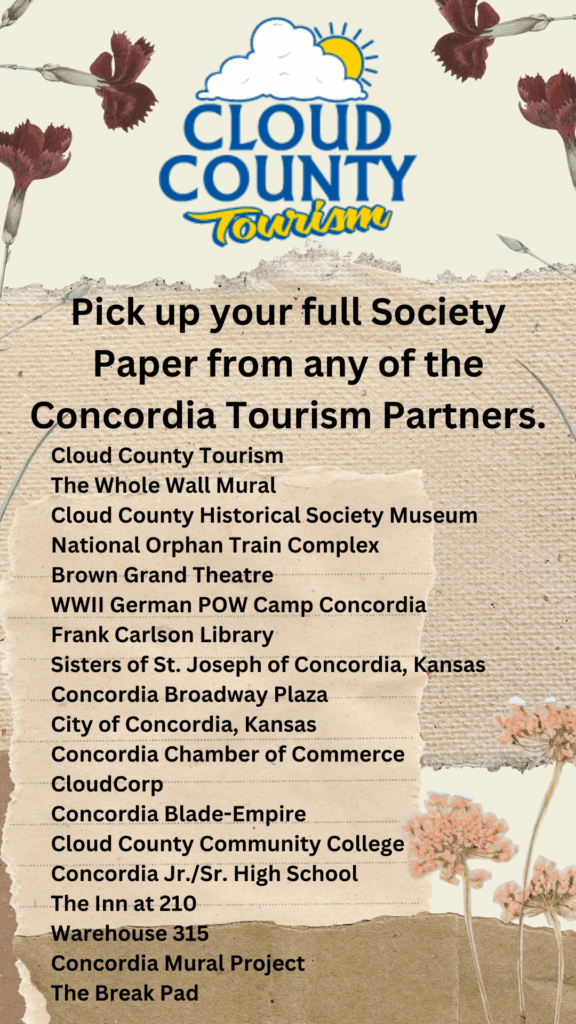
Information gathered is intended to be factual and entertaining compiled from multiple print sources and interviews of those who remember our histories. For more information on resources, please contact Cloud County Tourism.
Download your printable copy here. (Be sure to fold the paper in half lengthwise for ease of readability.)
