There’s something about the nostalgia of a circus that makes our eyes brighten, our hearts race in anticipation, and our minds get lost in the magic. Days of the big circuses in Concordia have long past, but those glory days shouldn’t be forgotten. We tend to see the circus with skepticism and sometimes jaded views in this modern age of information. We don’t see it with quite the level of awe and magic we did as children or years gone by.
Lady Shirley asks us to travel back with her to a time when the circus was not only big in Concordia but the BIGGEST! Set our skepticism and jadedness aside for just a moment and recall the wonder and excitement the circus once held. Ladies and gentlemen, boys and girls…the show is about to begin! I present to you, your Ringmaster…Lady Shirley.
THE GREATEST SHOW
Ladies and Gentlemen, boys and girls, this is the moment you’ve all been waiting for! The circus has been a curiosity throughout the world since the 1700’s, with the first traveling circus in 1871. The first circus to Concordia came in 1876. Many of the great circuses such as Ringling Brothers and Barnum & Bailey, Wild Bill Hickock, and Buffalo Bill shows made their way to Concordia as well as many smaller shows. Ringling Brothers and Barnum & Bailey were the most popular, but all were well received. In those early traveling circus days, Concordia was well known as the circus town. This author shall not endeavor to list them all, but a few stories simply must be told.
AND ALL THAT WAS REAL WAS LEFT BEHIND
One of this author’s favorite modern-day movies is “The Greatest Showman.” It follows the life of Phinneas T. Barnum, rather loosely, however. But one does find themselves enthralled with Mr. Barnum and his Circus. As the circus tent rises and three rings set the stage, the circus unfolds. I close my eyes and put myself in the circus stands of many years ago.
Shocking characters of the era, a bearded woman, conjoined twins, a three-foot tall man, and many more, made up Barnum’s sideshow, all for spectacle. As uncouth is it may seem today, Barnum paid a fair wage and is said to have treated them, people society had all but discarded, as family. By the 1940’s the “sideshow” acts were no longer a part of the circus. Science, understanding, and compassion for these human beings brought advocacy for those put on display. Death defying and daring acts, exotic animals, and funny clowns, however, continue to grace the three-ring circus, providing much awe and wonder.
Entering into the enormous circus tent, filled with excited spectators, amazing acts and curiosities unknown to our native lands, the stresses and pressures of the day could be put away “and all that was real was left behind.”
THE SHOW MUST GO ON
Concordia had the greatest crowd under any circus tent witnessed, in 1919, an estimated 15,000 circus goers attended the “greatest show on earth!” In 1922, Concordia broke the record again. Not to be outdone, though no other had come close, Concordia once again broke their own record in 1924. Over 16,000 people attended the show in a town of just around 7,200. It is said that as many as 2000 hopeful spectators were turned away that day.
To-day the Guiness World Record for the “Largest Audience at a Circus Performance” belongs to New Orleans, LA with a whopping 52,385 people in attendance at the Superdome on September 14, 1975. However, Concordia still holds its place in the Guiness World Record for the “Largest Audience at a Circus Tent” for the Ringling Brothers and Barnum & Bailey Circus on September 13, 1924 with 16,702 in attendance (15,686 paid). This author is highly impressed!
The Ringling Brothers and Barnum & Bailey Circus arrived in the Ton on Saturday, September 25, 1915. While not the first time the circus came to town or this particular circus, this date holds sopping significance as a heavy rain soaked all of northern Kansas the night before and off and on throughout the day. Though streets were beginning to become paved, the road to the fairgrounds was not. Automobiles were still primitive and venturing out into the mud made attending the circus an even bigger adventure than originally planned. By noon that day, vehicles lined all roads leading to Concordia, stuck in the muddy ditches. Many of their passengers’ hopes and excitement were squashed in the muck, never making it to the circus. Four railroads anticipated unusually large passenger traffic. Extra coaches had to be added and they were said to have all been crowded. Horses and buggies came by the thousands, some traveling quite the distances.
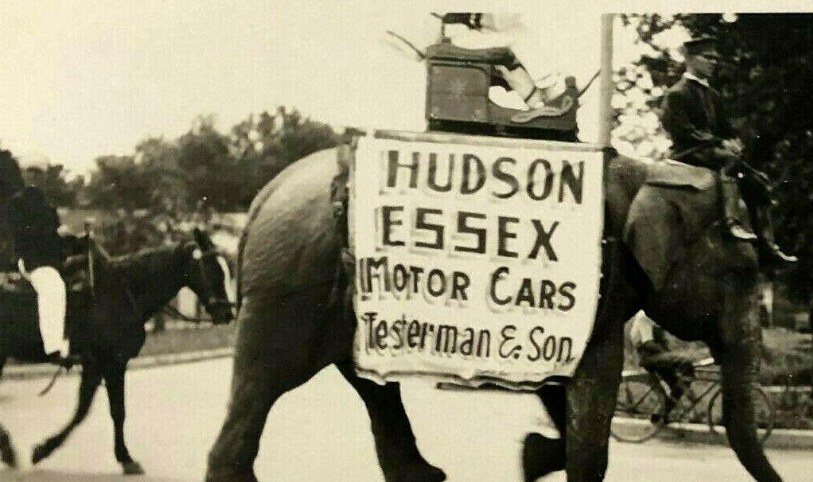
When the circus came to the Ton, the animals would be paraded through the streets to the Fairgrounds where the tent would be erected. What a sight it must have been to see dappled horses and elephants march down the street!
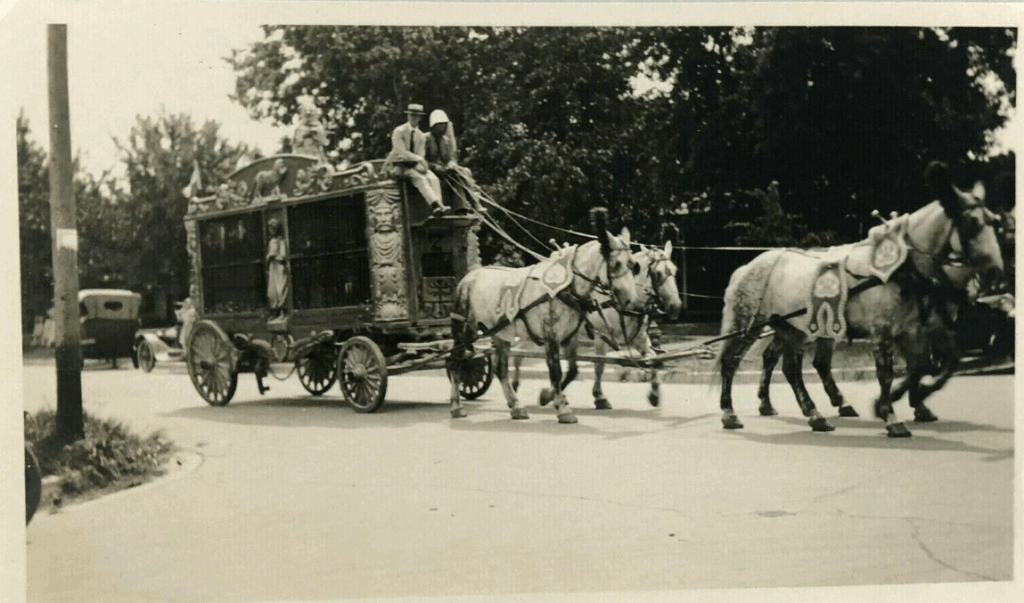
Due to the deplorable conditions of the roads, the circus street parade had to be cancelled. In the words of one Clarence Paulson many years later in an article on the subject, “nevertheless it had to transport all of its many railroad car loads of personnel, animals and equipment to the fairgrounds over Seventh Street. After all this traffic of steel-tired wagons drawn by mules, horses and elephants over the unpaved portion of the street, the street became a loblolly. And the pedestrian paths beyond the sidewalks became, after their churning by thousands of human feet, a gooey alluvium a foot deep with about the density and appearance of thick gravy.”
An unnamed writer from Downs, Ks traveled along with 253 others of Downs to see the circus. They joyfully followed the sidewalks from the train until the sidewalk ran out, along with their joy. He wrote of the muddy mess “The greatest show on earth is the human family when it has made up its mind to see the greatest show on earth. Light frost or drizzle will keep people away from church, but nothing can keep them away from the circus.” Jumping over puddles, climbing over or under wire fences, trudging through the wet grounds of mud and water until they reached the circus tent, white shoes and dresses were far from pristine. He goes on to say “In spite of the awful conditions it was the best-natured crowd we have seen. People who were total strangers visited and jollied one another, and there were no signs of ill humor. All were in the same boat and they made the best of it.”
TRAIN WRECK
On a Tuesday in 1892, May 17th to be exact, years before the previous story, tragedy struck the Circus as it was leaving Beloit, Ks, traveling through Concordia, to set up in Washington, Ks. The circus would then plan to return to Concordia for Wednesday’s show. However, the circus never made it to Washinton. It had been raining for about 10 days and due to the conditions, several shows had already been cancelled. The 40 car, Ringling Brothers Circus train was heading over a small waterway about a mile east of the railroad’s depot. The rains had flooded creeks and filled the culverts and ditches. Knowing the show must go on, the train was allowed to continue on so that it would not miss the next stop. A flood-weakened culvert was just ahead. Though the conductor saw the impending culvert, there was no time to stop.
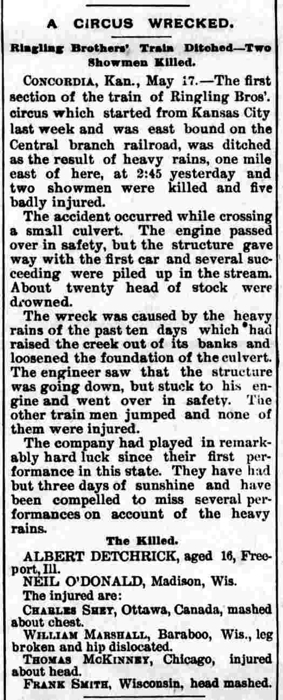
The engine derailed from the tracks, the next car upset, followed by four stock cars filled with men and horses. The next morning, when daylight brought forth the full nature of the devastation, 2 men had perished, 5 were injured, and at least 22 horses had been killed. Now tales over the years claimed that wild animals escaped the train and roamed the area, much to the terror of small children hearing the tale. Perhaps a ploy by parents to keep children from wandering too far and to keep out of trouble. Perhaps it was simply someone looking to stir up excitement, but alas, none of the wild animals escaped. Some of the horses, however, were roaming the countryside while the train was righted. Shockingly enough, the show did go on Wednesday here in Concordia, only missing the Washington date.
DID YOU SAY HIPPOPOTAMUS?
Did you know there’s an elephant buried outside of Concordia? Oh, yes, I heard it is at the Fairgrounds. Heavens no, I heard it was west of town toward Jamestown. Oh my! Are you certain? This author has heard that story a multitude of times. While the elephant burial hasn’t been recorded, there is a tale of a hippopotamus buried at the Fairgrounds. Around 1942 the Sells-Floto Circus settled into town at the Fairgrounds. With it came the many wild, exotic animals the circus is known for, elephants, giraffes, gorillas, rhinoceroses, and a sickly hippopotamus. The circus veterinarian had cared as best he could for the sick animal with no progress. According to Clarence Paulsen in an article from 1977, a young Concordia boy, Rolland Hood, recalls that 1942 day stating, “the hippopotamus languished and died.” He says “If there is a problem more difficult of solution than what to do with a sick hippopotamus, it is how to dispose of a dead one! One can’t just throw it in the garbage can. Leaving it lying on the fairgrounds would be noticeable, to say the least. It is too bulky to hide. The show people excavated a large hole in the fairgrounds and buried the hippopotamus at a place with Rolland says he could point out if he had to.” Tall tales of an elephant burial may not be true, but if one believes Rolland, a hippopotamus rests at the fairgrounds!
WAIT! THERE WERE ELKS?
This author shall leave you with one last tale involving the circus and a bit of scandal because of it. This one involves the Wild Bill Hickock Show in 1900. You may recall the lengths J.M. Hagaman went to procure votes in the County Seat election from this author’s March letter. Well, it appears that the BPOE Elks Lodge took a page from Mr. Hagaman’s book. In 1900, the men of the Ton wished to open an Elks Lodge. Unfortunately for them, there was a requirement that a town must have a population of 5,000 people to open an Elks Lodge, which Concordia had not. Park Pulsifer, a local lawyer, saw to it to work around that requirement. The Wild Bill Hickock wild west show was scheduled to move into town attracting people from miles away. This crafty lawyer decided to conduct a “census on the spot” the day of the show, and wouldn’t you know, with that census, he got his numbers and his lodge!
The Lady Shirley Society Papers are a Concordia Tourism Partners Collaboration.
Information gathered is intended to be factual and entertaining compiled from multiple print sources and interviews of those who remember our histories. For more information on resources, please contact Cloud County Tourism.
Download your printable copy here. (Be sure to fold the paper in half lengthwise for ease of readability.)
