Oh, what a fun topic for this Fourth Edition of Lady Shirley’s Society Papers! If you recall, Lady Shirley is based off of a fictional character from the Bridgerton novels and Netflix series, Lady Whistledown. Lady Whistledown writes her papers anonymously as women were not publishers in her time. Lady Shirley is anonymous as well, though thankfully not because women are not able to publish, but simply because it creates intrigue! This month, as we head into the National Orphan Train Complex’s Celebration of Orphan Train riders, Tourism Partners wanted to find a way to recognize the Orphan Train Movement. What better way than to recognize Anna Laura Hill, first woman placing agent with the Children’s Aid Society?
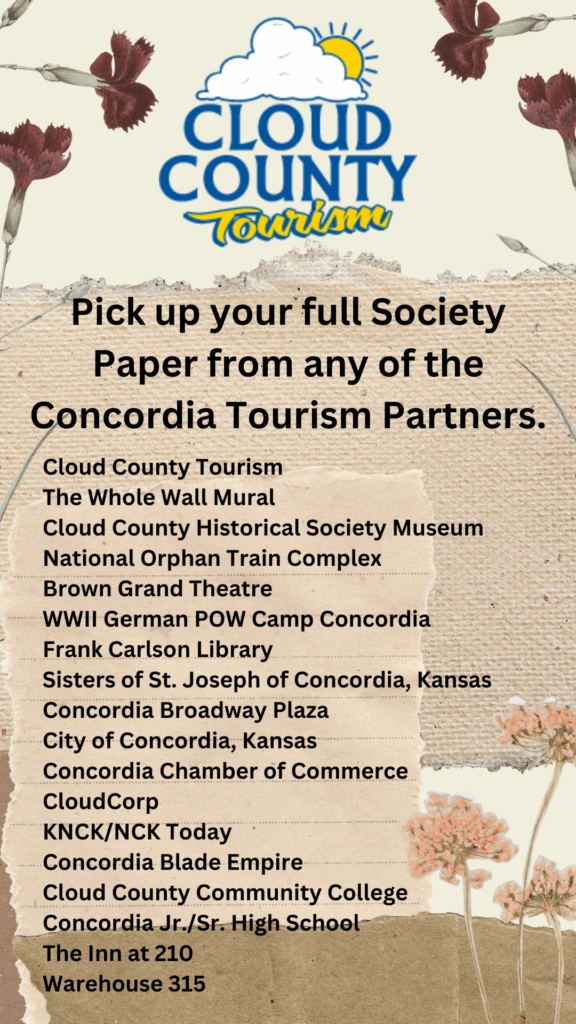
As you read through this month’s Lady Shirley, take note of each of the women. They all play roles that tie into our Tourism Partners. Lady Shirley is a project of the Concordia Tourism Partners, comprised of the Concordia attractions, economic development, commerce, government, and educational entities all working together toward a common goal of creating an exciting and welcoming experience for visitors and our community members. They include Cloud County Tourism, the Cloud County Historical Society Museum, the National Orphan Train Complex, WWII German POW Camp Concordia, the Brown Grand Theatre, Broadway Plaza, the Sisters of St. Joseph Nazareth Convent, the Frank Carlson Library, City of Concordia, CloudCorp, Concordia Chamber of Commerce, KNCK, Concordia Blade-Empire, Concordia Jr/Sr. High School CTE, Cloud County Community College, the Inn at 210, and Warehouse 315.
As we begin with Marion Ellet, note her ties to the Concordia Blade-Empire. There is a nice display at the Cloud County Museum for Marion Ellet. Note Minnie May McKay’s ties to the Nazareth Convent as well as Cloud County administration. Gertude Brown has ties to both the Brown Grand Theatre and the Concordia Blade-Empire. Read further about the bravery of the officer’s wives at POW Camp Concordia, Anna Laura Hill with the National Orphan Train Complex, and ending with Marian Cook who’s ties to the community as a whole ran deep as well as Cloud County Community College and the Brown Grand. Be sure to visit these Tourism Partners and imagine yourself in the shoes of these incredible women of Cloud County.
Now, let’s get to what you came here for…Lady Shirley
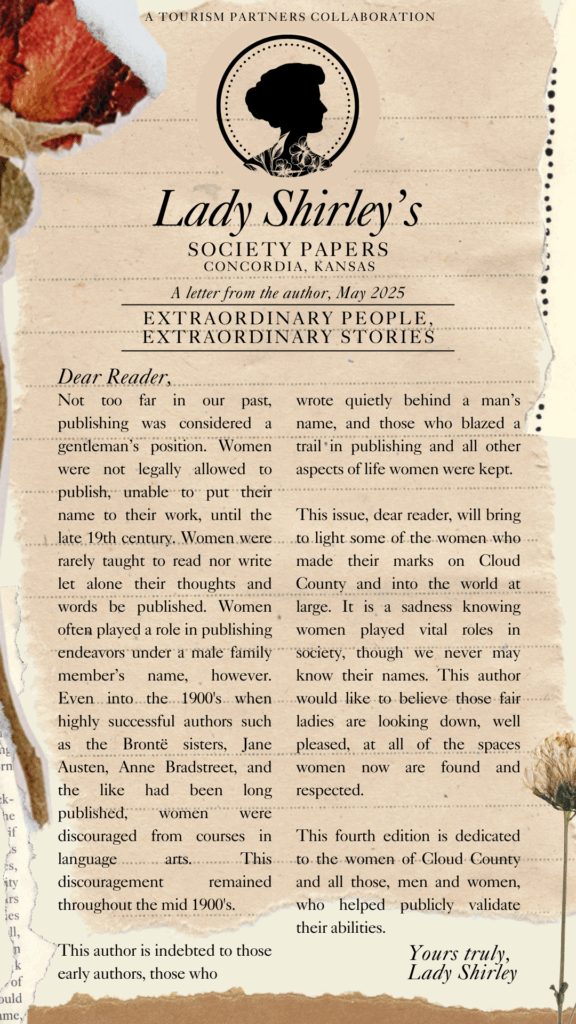
WOMEN CAN’T DO THAT
This author recently ran across an on-line article from historycollection.com of 40 Basic Rights Women Did Not Have Before The 1970s. 1970? Yes, dear reader, 1970. Here is condensed list of 5 which may or may not surprise you.
- Have a credit card in her name. (1974)
- Serve on a jury in all 50 states. (1975)
- Not be fired for becoming pregnant. (1978)
- Receive an education at all Ivy League Colleges. (1981)
- Serve on the front lines of battle in the military (2013)
MARION ELLET
Marion Ellet’s story is one of this author’s favorites. Her mother was the first child born in our fair Ton. Marion, too, was born in Concordia in the Sturges home, one of the oldest homes in Concordia to-day. Her parents moved to Kansas City, Mo after her birth. She once wrote, “Of course I lived in Kansas City and went to school there but I spent all of my vacations in Concordia. Christmas and Easter and summer vacations. I never returned to Kansas City in the autumn until the day before school began. I didn’t like city life.”
Marion Ellet was a talented journalist and a force to be reckoned with. From the young age of 7, Miss Ellet loved writing. By 16, she was an award-winning playwright, winning $25 for a play then performed at Barstow School. After graduating high school, Marion attended Smith College in Northampton, MA. She worked in New York for four years at the New York Times, Hearst magazines, and the Brooklyn Eagle. She referred to those years as excellent training and exciting times. She desired to return to Concordia in 1925 where she continued her career in journalism with the Blade-Empire. Her column, Mugwump Musings, was controversial and nationally recognized for her political commentaries. Her writings were fearless and pushed boundaries most women only feared to approach, at least in the public eye. She stood shoulder to shoulder with many great men of her time. Her column was reprinted across Kansas and nationally from California to Kansas City to New York. A friend of the great William Allen White, his son William Lindsey White, nationally respected journalist, foreign correspondent, and writer, referred to Miss Ellet as “our best Kansas writer and thinker.” He says in an article in the Emporia Gazette, “The tragedy is that out here in the Corn Belt, she has an audience too small to appreciate the delicacy of her artistry. She must sit there, up in Concordia, and watch so many shrill phonies rise to wealth and fame. Well don’t pity her. She knows they are phonies, and that she is good.” Such high regard from men of the time tells much. Marion Ellet knew she was good. She knew she could excel at national publications but preferred the small rural life of Concordia. When faced with the ever-present question as to why she was not nationally known Miss Ellet finally commented, “Sometime ago Scripps-Howard wanted to buy my column. But they insisted I live in Washington and that I write nothing but politics. If I had accepted, I’d be living in a hirize (sic) apartment today, taking hand-outs from officials, getting laughed at if I asked leading questions at press conferences, earning four times what I earn today, spending five times what I earned, battling traffic and struggling for parking space, going to endless cocktail parties, being homesick for the rough and tumble of country politics…” Marian Ellet knew her worth. She also knew what she wanted from life. She was highly educated, traveled extensively, was attuned to the goings on of the world at large, and was unafraid to speak her mind. Today she would be much heralded and we would likely see her face on every national news outlet. But she also knew exactly where she wanted to be, in Concordia, with a life she alone ordained.
While this author could go on and on about Ms. Ellet, these parting thoughts must suffice in her own words printed in the Belleville Telescope in 1940. “If you would be an educated person, first learn to read, and then read. Expose your mind to the great thoughts of the masters. Then when you’re out associating with your fellow men try to associate yourself with persons who know more than you do, and when they talk just listen. If you would develop character, associate yourself with persons of good character. Only a dumb person can remain illiterate. We are exposed to learning on every hand. Develop a receptive mind. Do that, and much information and good thoughts will get into it. All things seek their own. as the wind seeks the prairie grasses and the bird the sheltering tree.”
MINNIE MAY MCKAY
Long before women held the right to vote, Miss Minnie May McKay was the first woman elected Cloud County Treasurer in 1910. This author found record of Minne May McKay in a Special Booster Edition of the Blade-Empire, June 1912. It states she “was one of the most popular and well-liked among the county’s large number of admirable women. …being naturally of an energetic and ambitious turn of mind” She found her first employment at the Colson Hotel as a bookkeeper where she saved enough money to attend business courses at the Nazareth Convent Academy from where she graduated. Her bookkeeping skills and business courses led to her qualification to secure a clerical position with the County Treasurer. When it came time to elect a new County Treasurer in 1910, with much pressure from her friends, she entered nervously into the race. She was confident of her abilities and her competency was unquestioned by her peers, but she feared politics “a new and unknown territory into the borders of which she was rather timid about entering.” Her fear would soon be diminished when she indeed secured the office by a majority of votes. She excelled the job as County Treasurer and was said to be “superior to most men in the same position, her natural feminine charm has remained unsullied.” Miss McKay was wholly modest, her integrity unassailable, her good nature unfailing. Nazareth Academy was certainly proud to name her amongst distinguished graduates.
GERTRUDE BROWN
Amongst the stories of the Brown Grand Theatre is one of Gertrude Brown. She was the wife of Earl Van Dorn Brown, Col. Napoleon Bonapart Brown’s son. If, dear reader, you ever have chance to visit the Brown Grand do make a request as to receive a tour by its director, Mellissa Swenson. You will hear her tell of Gertrude and her unnamed part in constructing the theatre. Gertrude had a love of theatre and architecture. However, being a woman, she was unable to pursue that love as a career.
Earl and Gertrude used their travel and love of theater as inspiration to contribute to the construction plans. Gertrude indeed had a significant hand in the designing of the theatre, though you’ll only find official mention of Earl Brown, Carl Bowler, and W.T. Short. After the death of her husband, Gertrude and her mother-in-law, Catherine, attempted to run the theatre for a time with the investment of Mr. Ray Green, owner of the Blade and Gertrude’s second husband. They eventually gifted the theatre to the City of Concordia. It had been both the Colonel and Earl’s wishes that the city have ownership before their deaths. The women asked only for a few dates each year for free usage of the theatre. The women wanted to insure the children’s programs they organized yearly would remain and additionally requested free use of the two lower box seats on the west side of the theatre at all times. Women’s requests were not always entertained, but the Brown women were upstanding Society women and received their requests.
THE BRAVE OFFICER’S WIVES
An intriguing story was sent to this author in recent days. While it is well documented that POW Camp Concordia was a peaceful camp, this out of the ordinary event catches one’s interest.
On October 23, 1943, an incident occurred in the Officer’s Club. Captain Roberts was the Company Commander and the Duty Officer at the club that night. He had been drinking and became involved in an argument with Captain King’s wife and daughter. Colonel Sterling’s wife witnessed the argument and saw that the drunken Roberts was preparing to pull his service pistol. Mrs. Sterling stepped between Roberts and Mrs. King and was shot in the back! Mrs. King and her daughter scuffled with Roberts until aid came. He was immediately taken to the guardhouse. Mrs. Sterling did recover from her wound. Such bravery!
ANNA LAURA HILL
While not a resident of Cloud County, Anna Laura Hill deserves mention here. The first women’s placing agent for the Midwest for the Children’s Aid Society of New York, Ms. Hill accompanied thousands of children on Orphan Trains finding them safe homes. She returned to children yearly to check on their welfare. The children held her with such love that she remained part of their lives long past their youths. Her nearly 30 years of service went above and beyond the call of duty.
MARIAN COOK
Marian Cook left quite the legacy on Concordia. If one had to condense her legacy into a few words it would be that she was a patron of the arts. Susan Sutton was once quoted saying, “For the better part of a century, Marian loomed large in this community, in ways so private that only those closest to her were aware.” She was a supporter, protector, and champion of the arts. A large supporter of the Brown Grand giving time, ideas, leadership, and money, she did so quietly without taking credit. She and her husband Charles were instrumental in the restoration planning of the Brown Grand and the Napoleon drop curtain restoration which hangs regally above the stage.
Marian used her financial blessings to begin the Cook Series, cultural and educational lectures, at Cloud County Community College. The intention was beginning it after her death, however, she remarked at the first Cook Series Lecture that, “dying is so tedious” she wanted to see it before she died. The Cook Series has brought numerous notable people to Concordia, always free to the public.
The Lady Shirley Society Papers are a Concordia Tourism Partners Collaboration
Information gathered is intended to be factual and entertaining compiled from multiple print sources and interviews of those who remember our histories. For more information on resources, please contact Cloud County Tourism.
Download your printable copy here. (Be sure to fold the paper in half lengthwise for ease of readability.)
