When reading the June Lady Shirley’s Society Paper, another example of things our community often overlooks or perhaps wasn’t taught enough about shines through. Both the Carnegie Library and Frank Carlson are the monuments and minds Lady Shirley reminds us of this month. There is so much more to uncover regarding these topics to continue our quest for remembering where we came from to find understanding of who we are today and lead us in the direction of who we wish to be in the future.


Dearest Reader,
Every town has its monuments which declare – not in boast, but in quiet confidence – the character of its people. Some rise in stone and mortar, dignified and enduring; others formed in the subtler substance of thought, principle, and learning. It is among the latter that a community reveals its truest refinement. For a town is not merely measured by the grandness of its buildings, nor the bustle of its streets, but by the company it keeps upon its shelves.
This June, as we celebrate the golden anniversary of the Frank Carlson Library, this author finds herself pondering monuments and minds. For what is a library, if not the most civilized of monuments? A lasting testament to the once radical notion, brought to fruition by Andrew Carnegie, that knowledge be made freely available to any willing to seek it. He believed prosperity, which he possessed in abundance, carried with it duty – to erect not merely fortunes, but opportunities. And so, he built monuments not of self-importance, but of the greater good: libraries.
Yet what is a library without those who make worthy use of its offerings? It is here that we find ourselves in the company of one of Concordia’s own – Kansas’ Favorite Son – Frank Carlson. His life in public service reflects more than ambition; it reveals a steady devotion to people, principle, and his Creator. A gentleman who, seated in quiet study or engaged in the affairs of state, understood well the value of an informed mind and a thoughtful people.
Thus, dear reader, wander through these quieter corridors of history and consider the enduring influence of books, the generosity that built their homes, and the character of those who have read them well.
For in the end, it is not enough to build monuments of stone; we must also cultivate the monuments of mind. Just as one may wander library shelves much as one strolls a familiar street, where new ideas await and old companions are warmly revisited, so too our lives are ever being written – filling the volumes one page at a time.
Yours truly,
Lady Shirley
KNOWELDGE FOR FREE
In today’s world, where most everything one would seek to find is at our fingertips, it is difficult to imagine a time when society did not universally believe that everyone should be granted the opportunity to obtain knowledge.
Even in Concordia’s infancy, the community recognized the importance of learning. In 1892 The Concordia Library Association – also known as the Ladies Library Association – was formally established. Membership dues were originally $2 annually but were soon reduced to $1. After initially meeting quietly in private homes, a group of mostly women, many wives of prominent men in town, officially organized in a room at the YMCA on 7th and Washington.
This first library began with about 65 books donated from community members. It later moved to a space above the Bolinger clothing store, where Me & Ma’s Bakery now stands. Colonel Brown donated funds for rent. By 1907, the association had moved into its own building on West 7th Street, and its collection had grown to around 160 books. It was at this point that the Ladies Library Association began looking toward a larger and more permanent location.
Enter Andrew Carnegie. Carnegie Libraries were appearing throughout the U.S. by this time and Concordia agreed that such a library would be ideal for our growing town. A man of immense wealth, Carnegie valued education and access to information and believed it should be freely available to all.
His vision of Free Public Libraries, however, was considered radical in some parts of the country, where access to education was often limited by class and race. Carnegie maintained that education, democracy, and peace were essential to a thriving society—and fortunately, many others agreed. Between 1900 and 1915, 66 Carnegie libraries were built in Kansas. By 1930, 1,681 had been established across the United States and 2,509 worldwide.
The Ladies Library Association was a hard-working group dedicated to the library’s success. They organized many events for the community in addition to maintaining the library. They had saved a considerable amount of money in hopes of building a larger library, so when the opportunity to get a Carnegie Library presented itself, they were devoted to making it a reality.
In 1908, Andrew Carnegie donated $10,000 for the construction of the new library. Provisions of this gift were that the city had to furnish the site, the books, and the furnishings, as well as bear the expense of operations and maintenance. The site was purchased for $2000 at 7th and Broadway. The Concordia Library sold its location for $1250, contributing those funds. The remaining balance was provided by three citizens – G.W. Marshall, W.W. Caldwell, and C.E. Sweet. An additional $1000 was raised in the community for furnishings and books.
The library was completed and opened in May 1909. In 1912, the Concordia Empire described the building: “The Concordia Carnegie Library, which is free to the public, like all the libraries founded by this philanthropist, is situated at the corner of Seventh and Broadway, and is one of the handsomest, as well as one of the most substantial, buildings in the city. The library is constructed of a known stone, chipped in what is known as the “broken Ashler style,” which is not only good for the eye to look upon, but lends a suggestion of rugged strength. In size the building is sixty-six by one hundred and six feet, and the height inside is fifteen feet. It is finished inside with oak, and the floor is of maple.” Furthermore, it stated, “boasts fully 5,000 volumes. Of these about two-thirds are fiction, consisting of the old classics and modern novels. A good proportion of the non-fiction books are scientific and historical. For a library of the size the juvenile department is very large and complete. The collection of four cases of stuffed birds and animals which has been loaned to the library for exhibit by Dr. F.E. Way, is one of the prominent features of interest.” The collection of books donated by Helen Gould, only a few years earlier, was of course transferred to the new library.
A NEW LIBRARY
A 1971 issue of the Belleville Telescope published a rendering of a proposed new building to house the collection of memorabilia accumulated by Senator Frank Carlson over his 40 years of public service. The project was to be funded in part with federal dollars and would also include space for the public library.
On June 30, 1976, the new Frank Carlson Library was dedicated. The project came in $20,000 under budget, with a total cost of $360,000. Frank Carlson’s good friend Art Linkletter – well-known for his radio and television programs, including the popular “Kids Say the Darndest Things” – was in attendance, along with a long list of dignitaries, the Fort Riley Military Band, and many friends, family members, and community residents.
The Frank Carlson Library celebrates its 50th anniversary this year (2026).
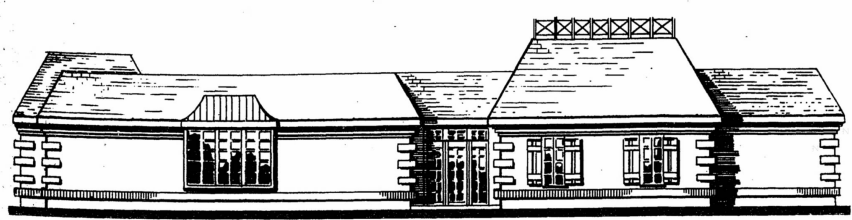
Proposed Frank Carlson Building – Belleville Telescope Jan 21, 1971
Kansas’ Favorite Son
Frank Carlson was born in Concordia on January 23, 1893, to Swedish immigrant parents. He was quite proud of his heritage. He grew up on a farm, and farming remained one of his greatest joys throughout his life. He graduated from Kansas State University and served as a private in the U.S. Army during World War I. After returning home, he married Alice Fredrickson. They had one daughter, Eunice (Rolfs), and a foster son, Millard Ross.
Carlson remains the only Kansan to have served in the Kansas House of Representatives, the U.S. House of Representatives, as the 30th Governor of Kansas, and in the U.S. Senate. Yet a 40-year political career was never his ambition – he would have been perfectly content farming.
In 1928, while cutting wheat, four friends pulled into the field. He was busy and not too happy to see them arrive. They came to ask permission to put his name on the legislative ballot. The Parsons Sun quoted Carlson’s recollection about that day. “I told them I didn’t have time to fool with that … They assured me that I wouldn’t have to worry, that I wouldn’t be elected.” They were wrong. He won that race – and never lost another, winning 12 consecutive elections.
He served two terms in the Kansas House of Representatives, where his work impressed state Republicans enough that they selected him as GOP chair the following year. He managed Alf Landon’s campaign for governor, and after Landon’s victory was offered any position in state government. Carlson declined, saying, “If it was all the same to him, I’d just go back to my farm.”
He spent just one year on the farm before he was asked to run again for the U.S. House. He joked, “I think they just wanted someone with manure on his shoes.” He was elected and would go on to win five additional terms. He later returned to Kansas to serve two terms as governor before being elected to the U.S. Senate, where he served for 18 years. When he chose not to seek reelection, he reflected, “No man is indispensable…It should be with wisdom and understanding that he realizes when it is time to step aside and let others assume this honor.”
Frank Carlson retired to his 500-acre farm outside Concordia, where he and his wife lived until his passing at age 94 in 1987. His passing was reported across the country including The New York Times and The Washington Post.
Frank Carlson’s career in politics was extensive, but it was his character that left the deepest impression. He was well loved from both sides of the aisle. William Lindsay White, described him as “lean, blue-eyed, pink-complected, tow-headed Swede … shrewd, blunt, sparing of speech, but always saying clearly whatever needed to be said with no swirls or flourishes.” He had a capacity for hard work both on the farm and in office.
White, who served with him on the Committee on Taxation, recalled, “Frank was always in his seat at the head of our table at the appointed hour.” Carlson played a key role in drafting the state’s first income tax law, mastering every detail. White said he “had every detail at his fingertips: … studied the problems so well and thought them out so deeply that you could only agree with him. So it was in the beginning, so it has been ever since.”
He was an advisor to Presidents Eisenhower and Johnson, named a delegate to the U.N., spearheaded water control and reservoir projects, led advocacy for agriculture, drafted the pay-as-you-go tax system, launched Kansas’ mental health program, a long-range highway program, and established the Presidential Prayer Breakfast. He was inducted into the Agricultural Hall of Fame in 1979.
Sen. Bob Dole said “He wrote the book when it came to class. Frank Carlson was one politician who never had an enemy.” Arthur Capper, Bob Dole, and Dwight D. Eisenhower would all agree, Frank Carlson was more than a politician – he was a friend.

Information gathered is intended to be factual and entertaining compiled from multiple print sources and interviews of those who remember our histories. For more information on resources, please contact Cloud County Tourism.
Download your printable copy here. (Be sure to fold the paper in half lengthwise for ease of readability.)
Watch the Lady Shirley introduction letter REEL here.
